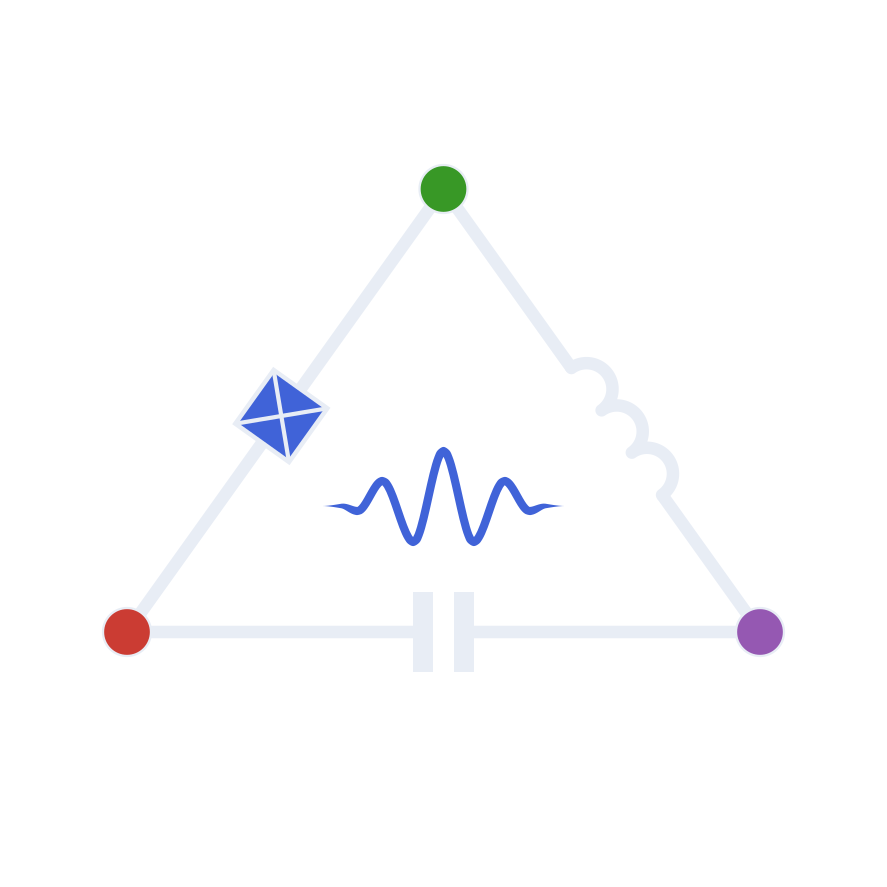
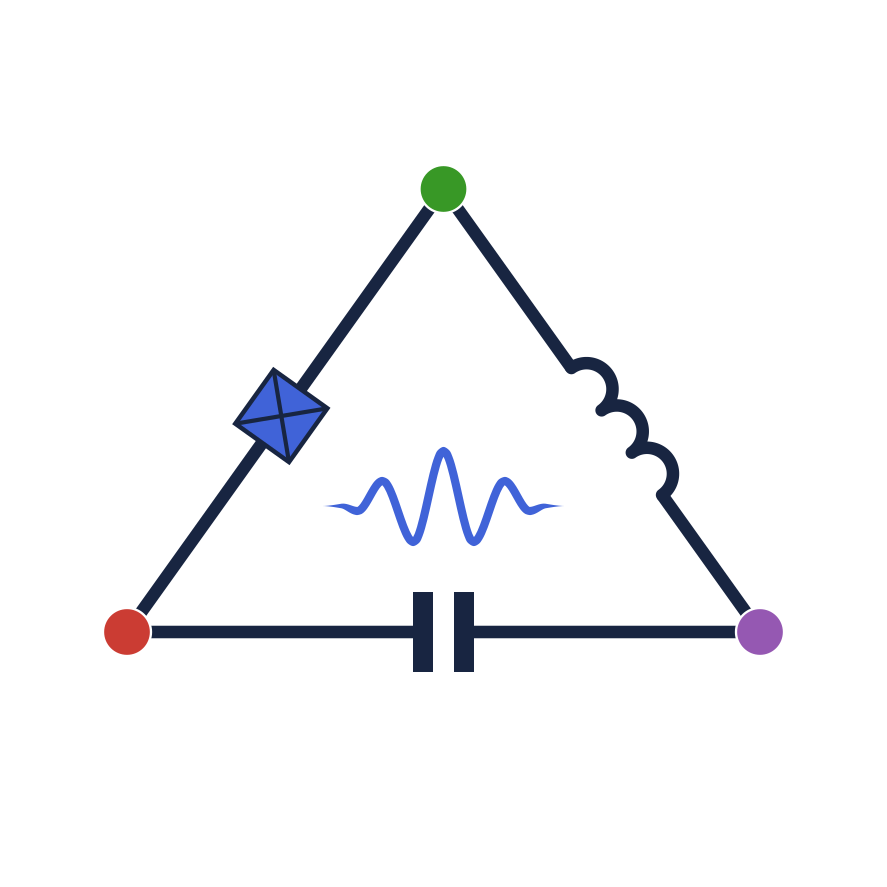
JPA with a frequency dependent environmental impedance
The current-pumped JPA of the first example, connected to a 40 Ω source through 5 cm of 50 Ω cable. The JPA no longer sees a matched environment but the source transformed by the cable, a different complex impedance at the signal, the idler and every pump harmonic, so the operating point moves as well as the signal response. Requires JosephsonCircuits and Plots.
 src                 1                 2
 o------[line]-------o------[cc]-------o--------+
 |                                     |        |
[p1]                                 [jj]     [cj]
 |                                     |        |
 o-------------------------------------o--------+
 0
The source is the port. A Port owns a matched source and load of its reference impedance, so Port(1; Z0 = 40.0) is the 40 Ω source, and its scattering parameters are referenced to it: abs2(S11) is the reflected power over the power the source makes available. The cable is a TransmissionLine between the source and the JPA, so the pump injected at the source reaches the junction through it, and the solver produces the mismatch between source, cable and JPA. The source's 40 Ω and the cable's 50 Ω, 5 cm and phase velocity of 2e8 m/s are assumed; the JPA and its pump are those of the first example.
using JosephsonCircuits
Cc, Lj, Cj = 100.0e-15, 1000.0e-12, 1000.0e-15
Z0, Rs, len, vp = 50.0, 40.0, 0.05, 2.0e8

ideal = Circuit([
    (:p1, 1, 0, Port(1; Z0 = 50.0)),
    (:cc, 1, 2, Capacitor(Cc)),
    (:jj, 2, 0, JosephsonJunction(Lj)),
    (:cj, 2, 0, Capacitor(Cj))])
cable = Circuit([
    (:p1, "src", 0, Port(1; Z0 = Rs)),
    (:line, "src", 1, TransmissionLine(Z0, len; vp)),
    (:cc, 1, 2, Capacitor(Cc)),
    (:jj, 2, 0, JosephsonJunction(Lj)),
    (:cj, 2, 0, Capacitor(Cj))])
With the pump off the circuit is linear. The JPA's impedance ZJ, its junction an inductance at zero phase, seen through the line, Zin = Z0 (ZJ + i Z0 tan(ωℓ/vp))/(Z0 + i ZJ tan(ωℓ/vp)), reflects (Zin - Rs)/(Zin + Rs) back to the source:
ws = 2pi .* [4.6e9, 4.75e9, 4.9e9]
off = hblinsolve(ws, cable; keyedarrays = false)
ZJ(w) = 1/(im*w*Cc) + 1/(im*w*Cj + 1/(im*w*Lj))
Zin(w) = Z0*(ZJ(w) + im*Z0*tan(w*len/vp))/(Z0 + im*ZJ(w)*tan(w*len/vp))
closed = [(Zin(w) - Rs)/(Zin(w) + Rs) for w in ws]
@assert isapprox(off.S[1, 1, :], closed; atol = 1e-12)
(solver = off.S[1, 1, :], closed = closed)
(solver = ComplexF64[-0.6677571125191464 - 0.7443792304196112im, -0.7610978123087375 + 0.648637125131497im, -0.667728329238937 - 0.7444050499101811im], closed = ComplexF64[-0.6677571125191478 - 0.7443792304196097im, -0.7610978123087345 + 0.648637125131501im, -0.6677283292389363 - 0.7444050499101806im])The pumped sweep, with the pump current of the first example:
using Plots
wsweep = 2pi .* (4.5:0.002:5.0) .* 1e9
wp = (2pi*4.75001e9,)
sources = [(mode = (1,), port = 1, current = 0.00565e-6)]
matched = hbsolve(wsweep, wp, sources, (8,), (16,), ideal)
@assert matched.nonlinear.solverinfo.converged
throughcable = hbsolve(wsweep, wp, sources, (8,), (16,), cable)
@assert throughcable.nonlinear.solverinfo.converged
gain(sol) = 10 .* log10.(abs2.(sol.linearized.S((0,), 1, (0,), 1, :)))
plot(wsweep ./ (2pi*1e9), [gain(matched) gain(throughcable)],
    label = ["matched 50 ohm source" "40 ohm source through the cable"],
    xlabel = "Frequency (GHz)", ylabel = "Gain (dB)")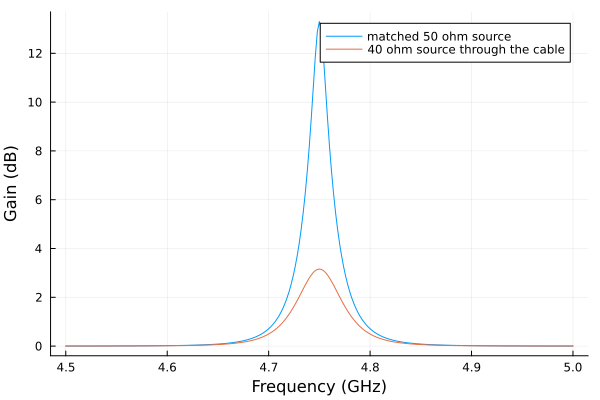
The matched JPA peaks at 13.3 dB at the pump frequency; through the cable, at the same pump current, it peaks at 3.2 dB. At the pump frequency the JPA sees the source through the cable as about 58 + 9i Ω instead of 50 Ω, a weaker coupling and a shifted resonance, and the pump, which also reaches it from a source of lower available power, leaves it far from its gain point:
Zenv(w) = Z0*(Rs + im*Z0*tan(w*len/vp))/(Z0 + im*Rs*tan(w*len/vp))
(matched = maximum(gain(matched)), throughcable = maximum(gain(throughcable)),
    environment = Zenv(wp[1]))
(matched = 13.302334075148018, throughcable = 3.1592185708334326, environment = 57.74365672310263 + 9.18667090748896im)Retune the pump for the environment rather than correcting the readout.